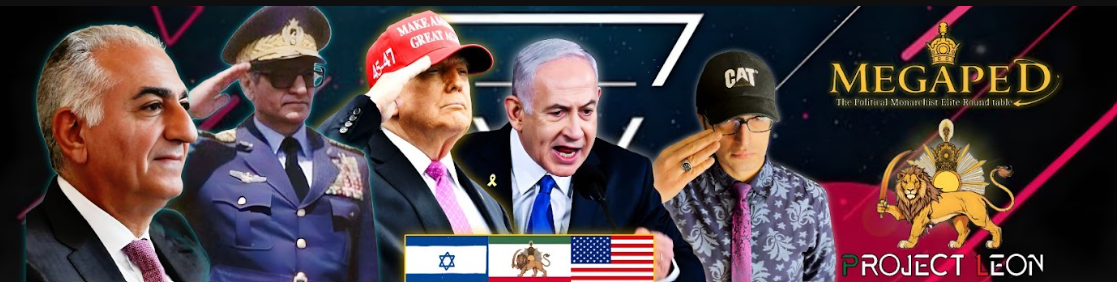

▶ Original broadcast in Farsi — English auto-generated subtitles enabled by default.
Watch on YouTube
The recent interview between ProjectLeon’s Leon and political analyst Kathrine Shakdam sheds unprecedented light on the complex interplay between Iran’s monarchy legacy, Israeli strategic interests, and the Trump administration’s Iran policy. This conversation emerges as one of the most challenging and crucial political analyses in recent years, centered on the prospects and codes of regime change in Tehran.
The Strategic Context
Iran remains at the fulcrum of Middle Eastern geopolitical tensions, with the ongoing contest between theocratic rule and pro-democracy movements creating a volatile environment. Against this backdrop, Israel’s security calculus and the United States’ fluctuating Iran policy under the Trump era have created a strategic triangle where regime change is both a stated objective and a contentious geopolitical puzzle. The legacy of the Pahlavi monarchy, symbolized by the late Shah, continues to influence opposition currents, while Israel’s Prime Minister Benjamin Netanyahu’s posture and Trump’s tactics intertwine in shaping regional outcomes.
Unpacking the Regime Change Codes: Shah, Netanyahu, Trump
In this interview, Kathrine Shakdam and Leon explore the “codes” embedded in the relationships among the Shah’s legacy, Netanyahu’s Israel, and Trump’s Iran policy. The Shah’s historical role is not merely nostalgic but serves as a symbolic and strategic foundation for pro-monarchist opposition forces seeking to restore Iran’s secular monarchy as a path to democracy. Netanyahu’s administration’s covert and overt support for these forces aligns with Israel’s long-term imperative to neutralize the Iranian regime’s nuclear and regional ambitions. Meanwhile, Trump’s “maximum pressure” campaign, coupled with backchannel communications, reveals a layered approach that oscillated between hard sanctions and tacit encouragement of internal dissent.
Leon emphasizes how the interplay among these actors is not random but coded with mutual interests and strategic signaling. The interview delves into how regime change is framed not just as a policy goal but as a carefully negotiated game of influence involving monarchist elements, Israeli intelligence, and select American policymakers. This triangulation challenges simplistic narratives of Iran’s opposition, highlighting a nuanced geopolitical chessboard.
What This Means
The implications of this analysis are profound for understanding both the internal dynamics of Iran’s opposition and the external forces shaping its trajectory. Recognizing the coded alliances among monarchist factions, Israel, and elements within the Trump administration reveals potential pathways for regime change that have been underestimated by mainstream analysts. It suggests a convergence of interests that could accelerate democratic transition efforts, albeit with considerable risks of escalation and proxy conflicts in the region.
Leon’s Assessment
From Leon’s perspective, this interview is a pivotal contribution to decoding the strategic undercurrents driving Iran’s future. He argues that the monarchist movement, often marginalized in Western discourse, is a critical actor whose alignment with Israel and parts of the U.S. policy apparatus represents a viable counterbalance to theocratic entrenchment. Leon underscores the necessity for international stakeholders, especially pro-democracy advocates and Israel’s allies, to engage more deeply with these coded dynamics to effectively support regime change that respects Iran’s sovereignty and democratic aspirations.
Leon is the founder and lead analyst of ProjectLeon International, specializing in Iranian geopolitics, the US-Israel-Iran strategic triangle, and the Iranian monarchist movement.