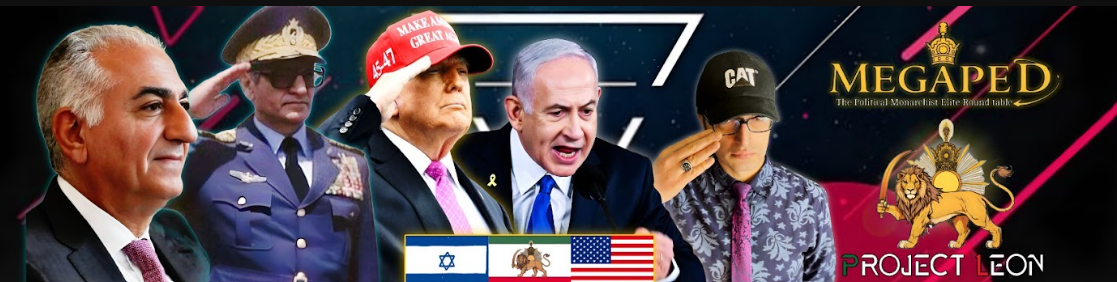

▶ Original broadcast in Farsi — English auto-generated subtitles enabled by default.
Watch on YouTube
Former President Donald Trump’s approach to Iran continues to reverberate across the Middle East. From his bold declarations about regime change to the deployment of overwhelming military force and the empowerment of covert partisan actors, Trump’s legacy shapes the current strategic environment. Leon’s latest analysis sheds light on these intertwined elements, revealing the broader implications for regional stability and US-Israel-Iran dynamics.
The Strategic Context
Trump’s tenure marked a decisive shift in US policy toward Iran, characterized by an uncompromising “maximum pressure” campaign aimed at destabilizing the Islamic Republic’s regime. This policy embraced not only crippling economic sanctions but also a willingness to escalate militarily, including the use of unprecedented ordnance such as the so-called “Mother of All Bombs.” Concurrently, the strategy incorporated the activation and support of partisan proxy groups to foment unrest and weaken Iran’s regional influence. The resulting tensions have intensified conflicts in neighboring Saudi Arabia and across the broader Middle East, complicating the geopolitical calculus for the US, Israel, and regional actors.
Analyzing Trump’s Multifaceted Regime Change Strategy
Leon highlights that Trump’s approach combined overt military might with covert operations, signaling a comprehensive plan to “change the regime” in Tehran. The reference to the “Mother of All Bombs” underscores not only the physical force employed but also the psychological warfare aimed at demonstrating US dominance and resolve. Meanwhile, the rise of partisans—irregular fighters supported indirectly—reflects a shift toward hybrid warfare tactics that aim to undermine Iran’s internal cohesion without provoking full-scale war.
Significantly, the increasing reports of mass killings and instability in Saudi Arabia, a key US ally and regional counterbalance to Iran, suggest that the conflict is spilling beyond national borders. Leon interprets this as evidence of Iran’s retaliatory maneuvers and the complex proxy battles unfolding beneath the surface. Furthermore, the cryptic “code from Bibi’s advisor” hints at the strategic synchronization between Israel and the Trump administration, emphasizing the intertwined security agendas that continue to influence policy decisions.
What This Means
The convergence of military escalation, proxy warfare, and political signaling under Trump’s policy framework has entrenched a volatile status quo in the Middle East. For analysts and policymakers, this means the region remains a tinderbox where miscalculations could rapidly escalate. The persistence of these dynamics complicates any prospects for diplomatic engagement with Iran and challenges US efforts to maintain regional alliances. Moreover, the empowerment of partisan groups raises concerns about the long-term fragmentation and destabilization in both Iran and neighboring states.
Leon’s Assessment
From Leon’s perspective, Trump’s strategy was a double-edged sword: while it succeeded in applying intense pressure on the Iranian regime, it also entrenched cycles of violence and proxy conflicts that now constrain regional stability. The use of overwhelming force, combined with covert partisan operations, signals a departure from traditional diplomacy toward a more confrontational stance that risks unintended consequences. Moving forward, Leon argues that a calibrated approach is necessary—one that balances firmness with strategic engagement—to dismantle the regime’s malign influence while avoiding broader conflagration. The analysis underscores the importance of understanding the nuanced interplay between overt military actions and covert proxy dynamics to anticipate future developments in the US-Israel-Iran axis.
Leon is the founder and lead analyst of ProjectLeon International, specializing in Iranian geopolitics, the US-Israel-Iran strategic triangle, and the Iranian monarchist movement.