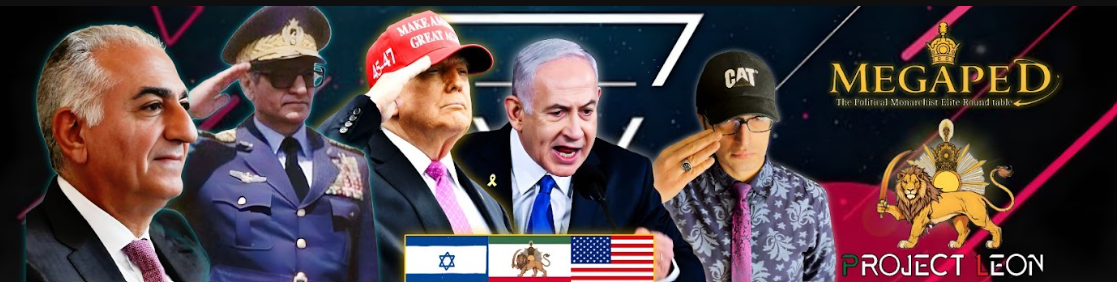

▶ Original broadcast in Farsi — English auto-generated subtitles enabled by default.
Watch on YouTube
Recent developments reveal a clandestine meeting between former US President Donald Trump and Israeli Prime Minister Benjamin Netanyahu in Washington, an encounter shrouded in secrecy but rich in geopolitical significance. Coupled with the presence of the exiled Iranian monarch, the Shah, this session hints at a recalibration of strategies in the ongoing US-Israel-Iran triangle, with undercurrents pointing towards renewed support for the Iranian monarchist movement.
The Strategic Context
The Middle East remains a theater of complex power plays, particularly revolving around Iran’s regional ambitions and nuclear aspirations. The US and Israel have long maintained a coordinated front to counter Tehran’s influence. However, the recent covert meeting in Washington, accompanied by high-profile events such as Senator Lindsey Graham’s ceremony, suggests a more nuanced approach is emerging. The involvement of the exiled Shah—representing the Pahlavi legacy—adds a symbolic and practical dimension to this evolving dynamic, potentially signaling a covert endorsement of monarchist elements as part of a broader strategy to undermine Iran’s current regime.
Decoding the Trump-Netanyahu Confidential Session
This secretive gathering between Trump and Netanyahu cannot be dismissed as routine political maneuvering. It likely served as a platform to synchronize approaches toward Iran’s destabilizing activities and to explore unconventional avenues for regime change. The Shah’s presence in Washington, possibly coinciding with this meeting, underscores the strategic value attributed to the monarchist opposition. Lindsey Graham’s ceremony—often a stage for political signaling—may function as a public-facing narrative to normalize and legitimize these covert alignments. These interconnected events suggest an orchestrated effort to leverage multiple fronts: diplomatic, political, and symbolic, aiming to erode the Islamic Republic’s grip.
What This Means for Regional Geopolitics
The convergence of these events signals a potential shift toward integrating the Iranian monarchist movement more openly into the US-Israel strategic calculus. This could translate into increased political and perhaps covert support for the Pahlavi cause, complicating Tehran’s calculations. Such developments may intensify pressure on the regime from within and abroad, altering the balance of power in the region. Moreover, this approach reflects a broader willingness by key actors to employ diverse tactics, beyond conventional sanctions and military threats, to influence Iran’s future trajectory.
Leon’s Assessment
From my perspective, this clandestine meeting and associated events represent a pivotal moment in the US-Israel-Iran dynamic. The deliberate involvement of the Shah signals a strategic pivot that recognizes the Iranian monarchist movement as a viable counterbalance to the current regime. While publicly downplayed, these maneuvers could lay the groundwork for a more assertive and multifaceted campaign to restore democracy and stability in Iran under the Pahlavi banner. For analysts and advocates of a democratic Iran allied with Israel and the West, this development warrants close attention as it may redefine the contours of regional power and resistance.
Leon is the founder and lead analyst of ProjectLeon International, specializing in Iranian geopolitics, the US-Israel-Iran strategic triangle, and the Iranian monarchist movement.